Stable Bipedal Gait
From my experience of building the Nix Robot, to balance the gait for a humanoid robot, one needs a good design. And here is the clue: look at the picture below.
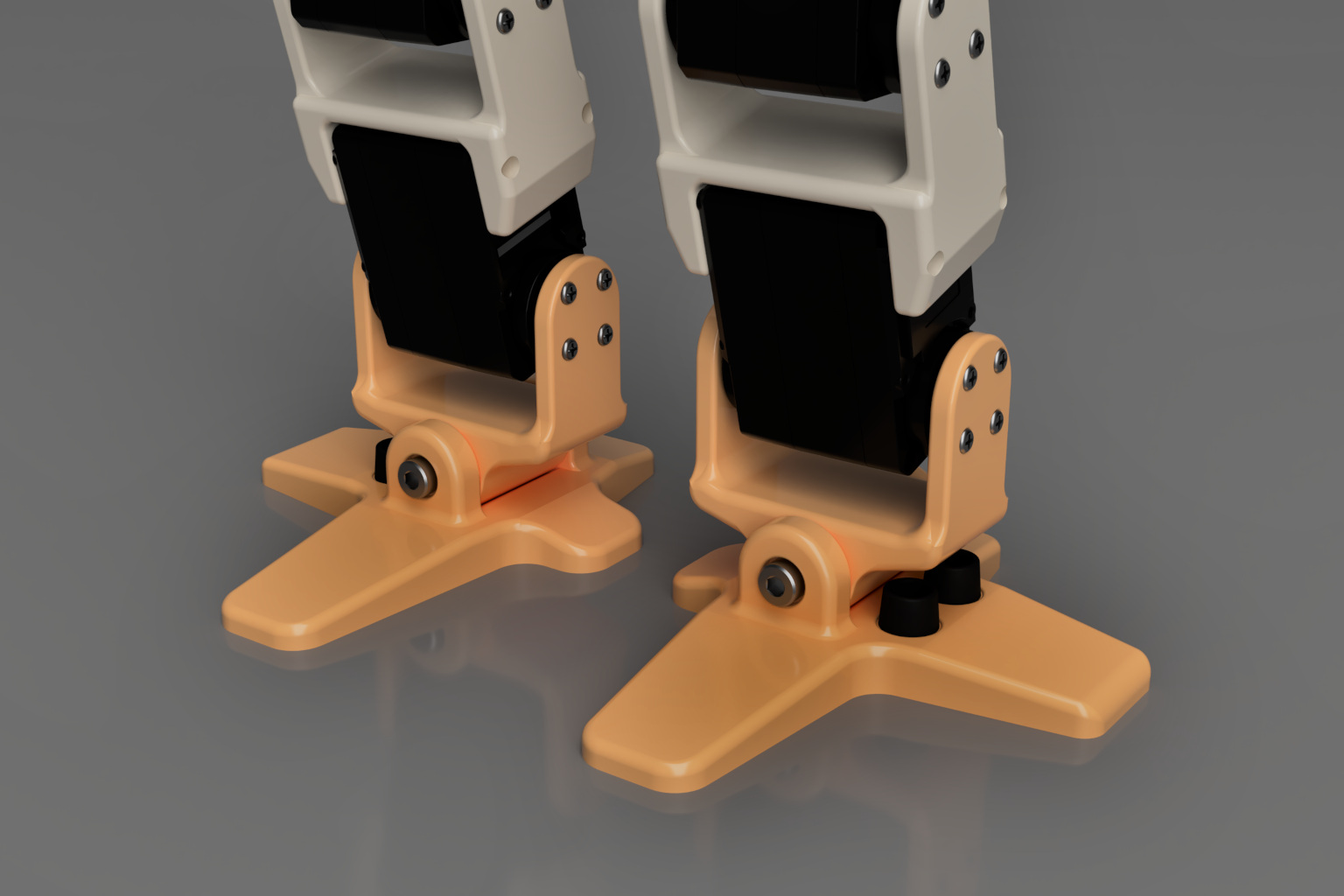
It shows the Nix Robot's feet. These feet are large enough for the robot to stay on the ground without needing to stomp or knead with its feet. While not moving, it can relax its servo motors, saving energy, and it will not fall. While moving, it will not fall because it can stand on one of its feet. Notice the X-shape or cross-like shape of the feet. This is what makes them especially stable.
Of course, it is not only design that defines the stability of the gait. Even the Nix Robot can fall if it makes an unbalanced move. Thus, to balance it in motion, we need to observe where its center of mass is at each moment. The center of mass is defined as the point at which all mass is deemed to be concentrated so that a complex system can move as a single point, and for that point only external forces are important. It depends on the distances of extended limbs or static features. One can intuitively understand that if you just lift a leg, it will outweigh the other leg if the robot is not tilted towards that second leg. With large feet area, everything could be coded based just on observable features.
Honestly, it is hard to understand why some engineers make robotic legs that are as thin as poles or sticks, and those machines can barely stand on them. Maybe it is a good engineering exercise. But we, humans, have normal feet with certain area, and that allows us to walk. Hence, the robots.
Page published: March 31, 2026